


Traditional sanctions enforcement was built for a world of banks, bank accounts, correspondent relationships, and jurisdictions. Freeze the account. Flag the wire. Block the bank.
Today those safeguards can be bypassed using blockchain technology. Crypto doesn’t play by those rules — and more and more examples show that people looking for an exit are finding one, more easily than ever.
One Example Among Many
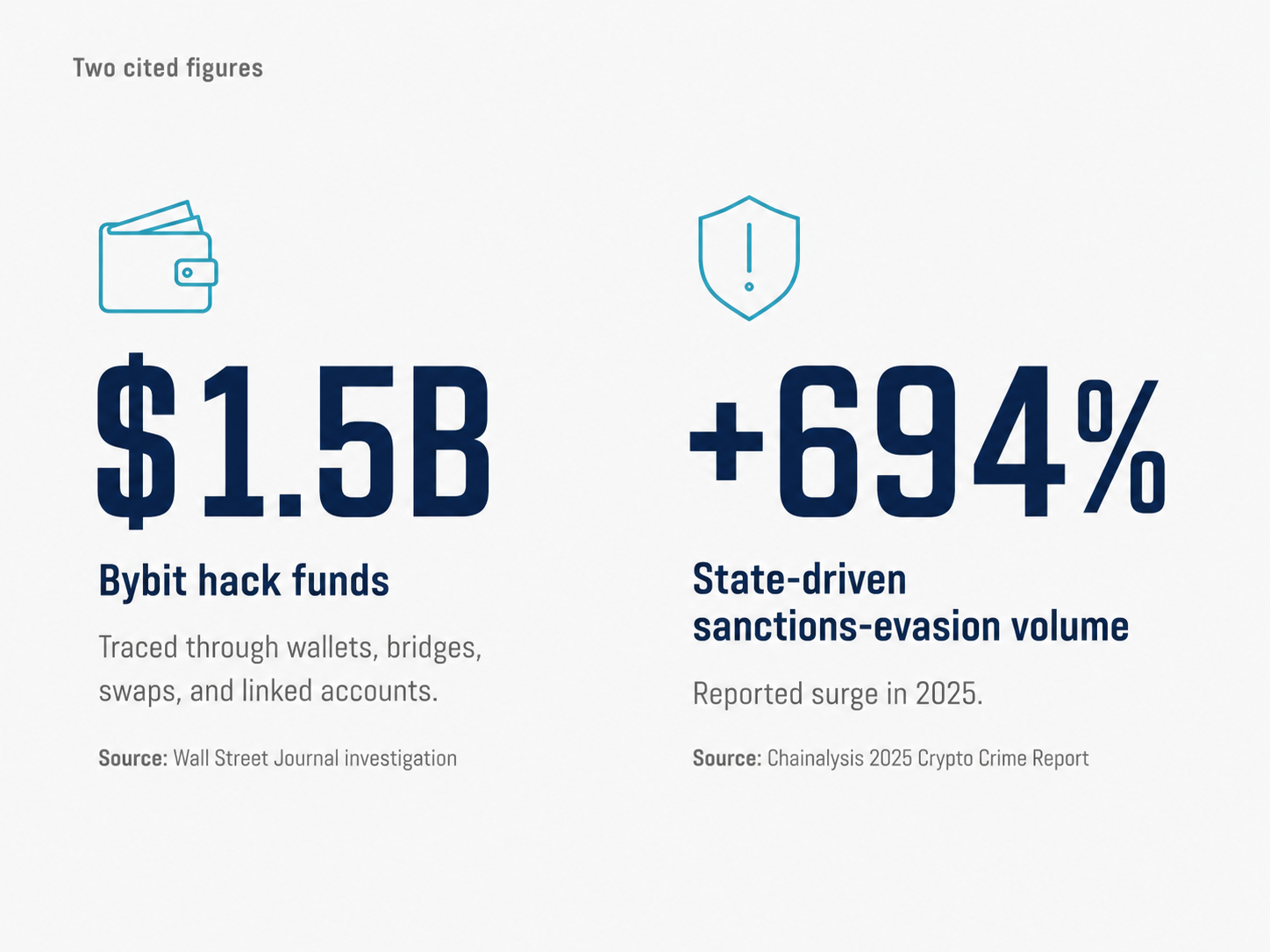
A Wall Street Journal investigation recently detailed how wallets linked to Iranian entities moved funds through CoinEx, a Seychelles-based exchange. According to blockchain analysis cited in the report, wallets tied to Iran moved more than $3.84 billion through CoinEx since 2019. The same investigation traced funds from North Korea’s $1.5 billion Bybit hack through a chain of wallets, bridges, swaps, and Iranian-linked exchange accounts.
The same dynamics show up across the map:
- Chainalysis reported that state-driven sanctions-evasion volume surged 694% in 2025.
- TRM Labs has documented how globally accessible service providers and stablecoins increasingly connect illicit actors, intermediaries, and markets at scale — regardless of which country or group is involved.
Different names, different regions, same underlying mechanism: funds move through decentralized rails faster than the systems meant to track them.
Why the Old Playbook No Longer Works
Crypto moves through wallets, stablecoins, cross-chain bridges, decentralized protocols, offshore exchanges, and self-custody infrastructure — none of which was designed to answer to a single bank, regulator, or jurisdiction.
Crypto isn’t the villain in this story — it’s simply indifferent to borders and jurisdictions in a way traditional finance was never built to be. It makes the monitoring problem fundamentally different. A sanctions list built for banks and account holders wasn’t built for a system with no single point of control.
The Question That Actually Matters
The compliance question of the last decade was straightforward: *is this person or entity on a sanctions list?*
The question now is harder: *does this flow of funds behave like sanctions evasion — before it disappears into the next layer of the system?*
Crypto’s underlying promise — open and borderless money — is still real and still valuable. But applying traditional compliance methods to crypto cannot guarantee that fraud, money laundering, and sanctions evasion will be caught.
The infrastructure has changed. The methods used to police it have to change with it.
Sources
- Wall Street Journal investigation on Iran-linked crypto flows through CoinEx and funds from the Bybit hack, as cited in the article source package.
- Chainalysis 2026 Crypto Crime Report sanctions analysis, including the reported 694% surge in sanctioned-entity value received in 2025.
- TRM Labs analysis is referenced as supporting context for illicit crypto flow patterns and globally accessible service-provider risks.